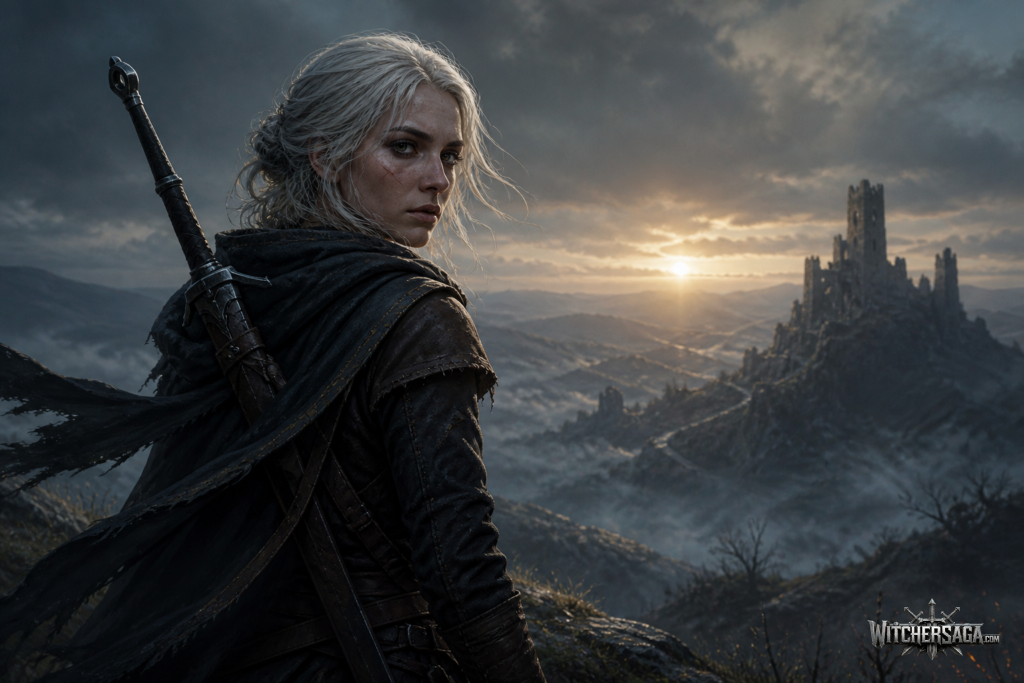
Two of the people shaping the story of The Witcher 4 sat down with Korean outlet Inven during G-STAR 2026 in Busan. Marcin Blacha, CD Projekt Red’s VP of Story, and Narrative Director Philipp Weber talked about what changes now that Ciri has taken over from Geralt as the protagonist, and what they want to keep from The Witcher 3. The interview was published in English by Inven Global on November 20–21.
To set expectations: there was no new release date, no gameplay and no platform news. CD Projekt Red’s public target for The Witcher 4 is still 2028. What the interview offers is a look at how the writers are thinking.
Writing for Ciri instead of Geralt
According to Weber, the question in the writers’ room has shifted from how Geralt would react to what Ciri would choose. He said she may take harsher decisions in some situations and act more directly in others. Blacha described Ciri as more hot-headed and more emotional than Geralt, and said the team wants players to be emotionally involved in quests rather than standing back as neutral judges, the role Geralt often played as a hired witcher.
In a separate G-CON talk at the same show, covered by Inven Global earlier in the week, the pair said the challenge is giving players real choice while keeping Ciri’s established personality and moral code intact. Ciri grew up training at Kaer Morhen, but the writers stressed she will not always reach the same conclusions Geralt would in the same situation.
A new entry point that keeps the edge
Weber said the core principles from The Witcher 3 have not changed: a game for adults that asks hard questions without easy answers. He also acknowledged that many players will arrive without having played the earlier games, more than a decade after Wild Hunt launched, so The Witcher 4 has to work as a starting point. He argued, though, that softening the series’ tone to reach a wider audience would backfire and end up pleasing nobody.
Blacha said every main Witcher game so far has been a big step for the studio, and that the ambition this time is another major leap that sets a new standard for RPGs.
Every quest has to earn its place
Weber said each quest, even a short side quest of 10 to 15 minutes, should offer something no other quest does, and that the team does not make quests just to fill time. Blacha explained that CD Projekt Red builds quests with a trio of disciplines – writers, quest and open-world designers, and cinematic designers – and that writers coming from novels have had to learn to tell stories without words, through camera and performance.
Blacha used the Bloody Baron as an example of what a Witcher story is: on the surface it is about a warlord, but at heart it is about a broken family. That storyline, which runs through Family Matters, is the kind of grounded, character-driven writing he says the team wants to carry forward, with the fantasy acting as a metaphor for real human problems.
What comes before The Witcher 4
The interview also mentions Songs of the Past, The Witcher 3’s new expansion, as coming next year ahead of The Witcher 4, which matches the 2027 plan. CD Projekt Red was showing a Korean-dubbed gameplay video of it at the same event, as we reported last week. The company’s Q3 2026 results are due on November 24, and we will cover anything said there about The Witcher. Until then, our Witcher 4 hub collects everything confirmed so far.